 Interpolation grids (paper-defined, non‑equidistant)
Audience: readers who want the conceptual and mathematical background.
For hands-on grid generation (CLI flags, file formats, validation), jump to How-to → Generate new grids. For a minimal quick-start command, see Tutorial → Generate grids.
The interpolation grid is one of DYNAMITE’s core design choices: it fixes where the two‑time Green’s functions are sampled on the triangular domain \(t'\le t\), and it ships with the quadrature weights, interpolation stencils, and index maps used to evaluate memory integrals efficiently.
Conceptually, the algorithm keeps a fixed number of samples in the dimensionless time ratio \(\theta=t'/t\in[0,1]\) and evolves only the outer time \(t\) with an adaptive ODE solver. The grid is chosen so that microscopic features near \(t'\approx t\) (small relative time) and near \(t'\approx 0\) (quench/onset region) remain resolved for all simulated ages \(t\).
This page explains (i) the basic idea and why it matters for accuracy/scaling, (ii) what’s stored under Grid_data/<L>/, and (iii) the paper equations used to generate the shipped grid.
Quick orientation
What is being gridded?
DYNAMITE parameterizes the triangular domain using the time ratio
The grid is a fixed set of monotone nodes \(\{\theta_i\}_{i=1}^N\) that is intentionally dense near \(\theta\approx 0\) and \(\theta\approx 1\).
Why non‑equidistant?
At long times, Green’s functions can retain sharp features for small relative times \(\tau=t-t'\lesssim\tau_{\rm micro}\) (i.e. very close to the diagonal \(t'\approx t\)), and (after a quench) can also remain sensitive to the early‑time region \(t'\lesssim\tau_{\rm micro}\). The key requirement is that the grid spacings be fine enough to resolve these microscopic scales when mapped back to physical time, while keeping the number of ratio nodes fixed.
This is captured by the resolution condition:
Practically, this is why the grid must be dense near \(\theta=0\) and \(\theta=1\).
Where does it show up in practice?
- Runtime interpolation uses precomputed stencils (indices + weights) derived from this fixed \(\theta\) grid.
- Memory integrals use spline‑consistent quadrature weights on the same nodes.
- All of these are bundled under
Grid_data/<L>/and loaded by the code at startup.
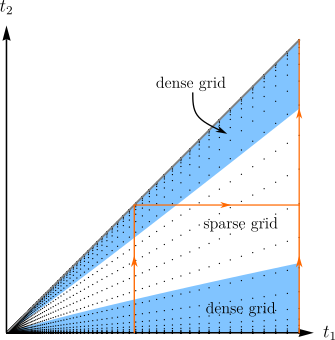
Only the triangular domain \(t' \le t\) is simulated. The algorithm samples functions as \(\mathcal A(t,\theta)\equiv A(t,\theta t)\) on a fixed irregular \(\theta\) grid, and (crucially) evaluates memory integrals by interpolating along derived contours that remain dense in the RG‑relevant regions.
DYNAMITE uses the non‑equidistant time grid defined in Lang–Sachdev–Diehl (Phys. Rev. Lett. 135, 247101 (2025), doi:10.1103/z64g-nqs6). All node locations and quadrature/interpolation metadata are precomputed and, for \(L=512\), these are shipped under Grid_data/512/.
On this page:
- Concept and code artifacts: what the shipped grid package contains and how runtime uses it.
- Exact definition: the explicit paper equations that define the base grid.
- Optional generator feature: the \(\alpha/\delta\) index remapping (defaults reproduce the paper grid exactly).
- Practical use: choosing \(L\), regeneration, and quick convergence checks.
Important: treat the grid choice as an algorithmic ingredient, not a cosmetic discretization. Using an equidistant grid will dramatically limit the accessible times.
What the files contain (and how the runtime uses them)
The grid package under Grid_data/<L>/ is meant to be complete: the code does not have to recompute interpolation topology or quadrature rules at runtime.
theta.dat— the fixed monotone node set \(\{\theta_i\}\) for \(\theta=t'/t\).phi1.dat,phi2.dat— the two contour families used to discretize the memory integrals in the paper (main text Eq. (3)), evaluated from the same base nodes:- \(\phi^{(1)}_{ij}=\theta_i\,\theta_j\) (dense near the onset / early times)
- \(\phi^{(2)}_{ij}=\theta_j+(1-\theta_j)\,\theta_i\) (dense near the diagonal / small relative time)
int.dat— quadrature weights (open‑clamped B‑spline; default \(s=5\)). By default these are generated via an index-space spline (--int-method index-spline) for better conditioning on highly nonuniform \(\theta\) grids.
Notation note: here we use \(\theta=t'/t\) for the time ratio. In data files, the node list is stored in
theta.dat. The auxiliary contour coordinates are stored asphi1.datandphi2.dat.
Interpolation metadata (for fast gathers during convolution / stencil evaluation):
posA1y.dat,posA2y.dat,posB2y.dat— physical positions of the interpolation stencils assembled from \(\theta\), \(\varphi^{(1)}\), \(\varphi^{(2)}\).indsA1y.dat,indsA2y.dat,indsB2y.dat— index maps into base arrays (e.g. \(C\), \(R\), and derivatives) for fast gathers.weightsA1y.dat,weightsA2y.dat,weightsB2y.dat— interpolation weights matching the index maps.
Provenance:
grid_params.txt— generator parameters (len, \(T_\max\), spline order, interpolation method/order, (floater-Hormann) FH window if rational, optionalalpha/delta, and the command line used).
Practical usage (where to look)
This page focuses on the why and the equations.
- For the full practical grid-generation reference (flags/defaults, outputs, validation workflow), see How-to → Generate new grids.
- For a fast “just generate the default grids” walkthrough, see Tutorial → Generate grids.
Explicit equations (as in Phys. Rev. Lett. 135, 247101 (2025))
We parametrize the two‑point functions on the triangular domain \(t_2 \le t_1\) by the time ratio \(\theta = t_2/t_1 \in [0,1]\), i.e.
The fixed irregular grid \(\{\theta_k\}_{k=1}^L\) (dense near \(0\) and \(1\)) is given by the supplemental Eq. (S1):
and the monotone arctan‑based mapping
Here \(\sigma_\infty\) is a large positive constant that fixes end‑point crowding; any choice that yields sufficient density near \(0\) and \(1\) for your \(t_{\max}\) is acceptable. This mapping is analytically invertible and yields near‑endpoint spacings that satisfy the resolution condition (paper Eq. (2)).
Optional index remapping (alpha/delta)
In addition to the paper‑exact grid above, the implementation supports an optional smooth non‑linear remapping of the fractional index prior to evaluating the underlying \(\Theta(x)\) mapping (i.e. before producing node locations in \(\theta\in[0,1]\)).
alpha∈ [0,1]: blends toward the non‑linear map.delta\(\ge 0\): controls the “softness” of the remapping.
The defaults alpha=0, delta=0 reproduce the paper grid exactly. Non‑zero alpha re‑distributes nodes while preserving monotonicity and endpoints. If used, values are recorded in Grid_data/<subdir>/grid_params.txt.
Closed form of the remapping
Let \(L\) be the grid length and let \(x\in[1, L]\) denote the 1‑based fractional index at which the original paper mapping \(\Theta(x)\) (the function that produces \(\theta\in[0,1]\)) is evaluated. Define
With a blend parameter \(\alpha\in[0,1]\) and softness \(\delta\ge 0\), the remapped index is
and the modified grid is obtained by composition with the original mapping:
Remarks:
- \(\alpha=0\) (any \(\delta\)) yields the identity in index space, i.e., the paper‑exact grid. \(\alpha=1\) applies the full non‑linear remapping.
- The normalization by \(g_1\) clamps the transform so that endpoints map to endpoints (monotone, range preserved).
For memory integrals (paper Eq. (3)), the paper introduces an integration variable \(\phi\) and uses two contour families on the same \(\theta\) grid:
These generate the “mixed” directions required by the convolution structure and define the 2D interpolation stencils used at runtime.
DYNAMITE uses the following notation in code and data:
- \(\{\theta_i\}\) (stored in
theta.dat). - The two induced contour families (stored in
phi1.datandphi2.dat). - Spline‑consistent quadrature weights (stored in
int.dat, B‑spline degree \(s\); default \(s=5\)). The recommended generator is--int-method index-spline.
Performance note
Using these paper‑defined non‑equidistant grids is the primary reason the method attains (sub)linear growth of cost with simulated time. Although the high interpolation orders make the method reasonably insensitive to the precise grid choice, the grid must be tailored to the system. Using an equidistant grid for aging dynamics will be highly inefficient as it must resolve both the slow emergent time scales of the aging regime and the fast microscopic scales.
Choosing L and checking convergence
- The code ships with a single set of grid parameters for \(L=512\) with \(\alpha=\delta=0\). Use larger L for higher fidelity and later times at higher cost.
- Validate by comparing observables (energy(t), C(t,t), C(t, α t)) across L.
- Near phase transitions, prefer larger L to capture critical scaling.
Inputs directory structure:
Grid_data/<L>/theta.dat,phi1.dat,phi2.dat,int.datGrid_data/<L>/posA1y.dat,posA2y.dat,posB2y.datGrid_data/<L>/indsA1y.dat,indsA2y.dat,indsB2y.datGrid_data/<L>/weightsA1y.dat,weightsA2y.dat,weightsB2y.dat